This Year's Fellowship
Every year, the NC STEM Policy Post-Graduate Fellowship aims to bridge the gap between science and policy by matching fellows with different state government offices. During the one-year fellowship, post-graduate students focus on policy topics related to science, technology, engineering, and mathematics. The program is facilitated by the NC Sea Grant in an effort to provide recent graduates professional experience before full-time careers.
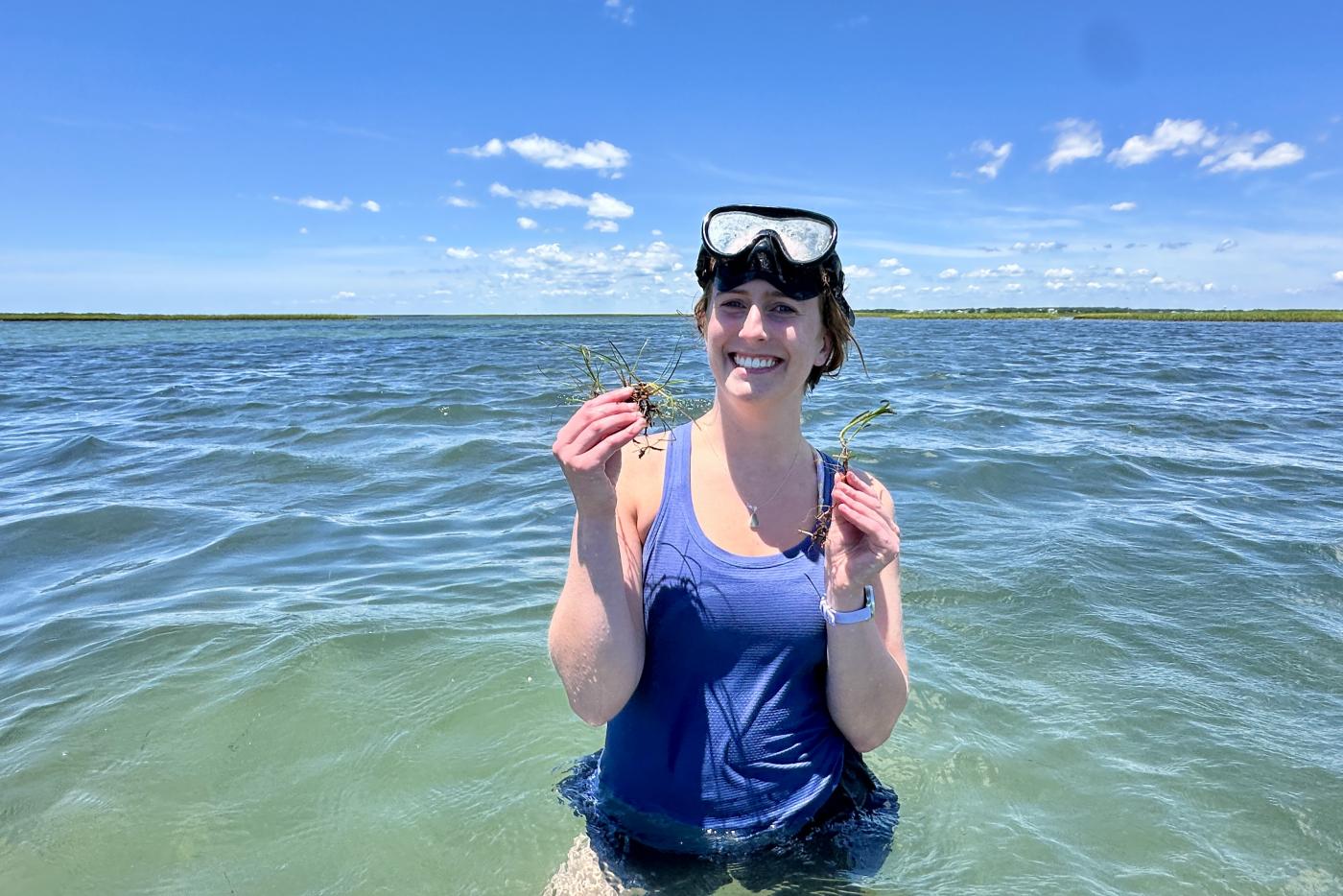
Last summer, APNEP was able to welcome their first STEM Policy fellow. The Partnership welcomed Riley Ragain in July of 2025, who set to work on a much-needed policy analysis of submerged aquatic vegetation (SAV) in North Carolina.
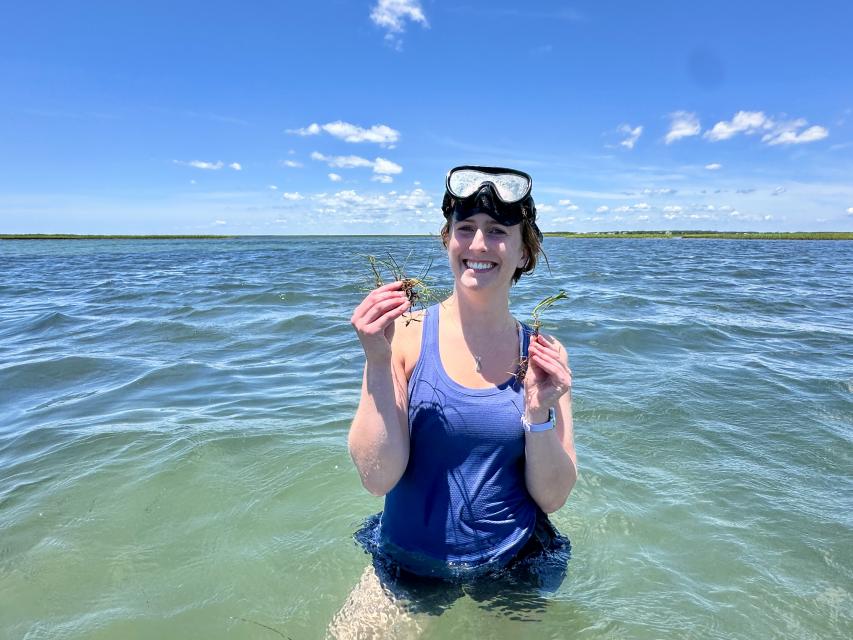
Ragain grew up in Portland, Oregon and went on to earn her B.S. in Environmental Science from the University of Idaho.
“I was really interested in the social aspects of environmental science,” she said.
Before attending graduate school at the University of North Carolina Wilmington (UNCW), Ragain spent two years as a deckhand in Alaska and New Zealand where she was on the water every day, surrounded by the marine ecosystems she now works closely with.
In Wilmington, she earned her Masters of Coastal and Ocean Policy, with a capstone project focusing on PFAS contamination in North Carolina.
“When I applied for this position, it wasn’t that I was specifically looking to work with seagrass, but it turned out to be the perfect project for me,” Ragain said.
The SAV Policy Analysis
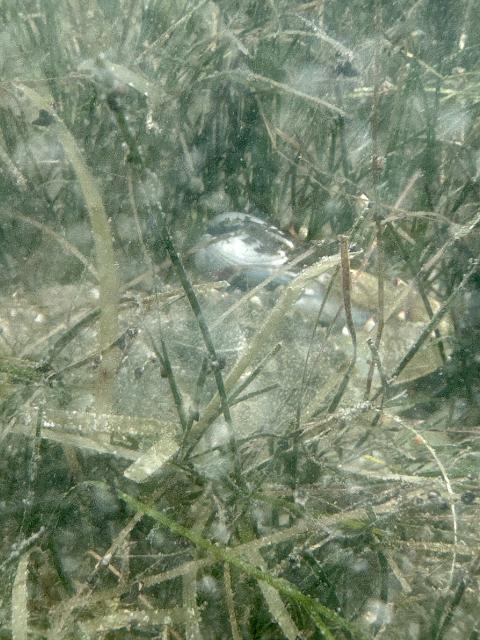
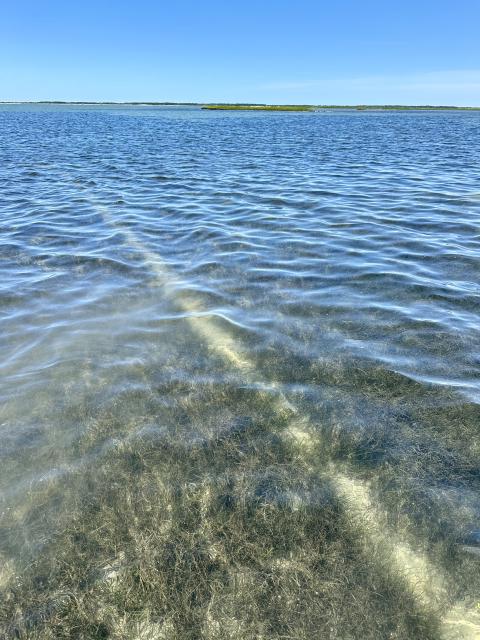
North Carolina has the second most SAV cover on the Atlantic Coast behind Florida. The calm, shallow waters of the Albemarle and Pamlico Sounds are ideal for growth, but cover has declined more than 16% over a 14-year period, according to a new assessment of survey data between 2006 and 2020. In another evaluation, APNEP found that a 50% loss of SAV cover in North Carolina would result in a loss of at least $88 million from declining fisheries, dropping property values, and reduced carbon storage. This decline could be attributed to various causes such as warming waters or water quality decline.
Before Ragain began, policy and information on SAV was scattered across agency websites, state plans, fishery management reports, and federal regulations with no single resource pulling it together. This is where Ragain stepped in. She is compiling a comprehensive policy and regulatory analysis of everything that affects SAV in North Carolina. The report is divided into five sections: mariculture, development, water quality, boating activity, and fisheries. For each of these, Ragain identified the existing laws, regulations, and permits, from federal statutes like the Clean Water Act and the Magnuson-Stevens Fishery Conservation Act, down to state-level tools like Coastal Area Management Act (CAMA) permits and the NC Dredge and Fill Law. She used these to evaluate where protection is strong, where it’s scattered, and where it’s missing entirely.
Ragain started with a literature review, working through APNEP’s Comprehension Conservation and Management Plan and the NC Coastal Habitat Protection Plan, which is the foundational state document for coastal habitat management and is currently being updated for 2026, as well as city meeting records and agency documents. Her aim is for the document to function as a management tool in conjunction with the policy analysis. policy analysis.
Looking Forward
“It will hopefully be a helpful document if somebody wants to understand [SAV] policies and regulations,” Ragain said. “For example, if someone identifies an issue with or damage to SAV, who can they contact? What are the regulations? Then, they can easily look at this document and find that information.”
Ragain pointed out that other endangered ecosystems like coral reefs and wetlands are more widely known as threatened, but the effects of SAV decline can be overlooked. When seagrass disappears, turbidity increases, harmful algal blooms become more frequent, and the juvenile fish that rely on seagrass beds for shelter struggle to survive to maturity.
“I would argue SAV [habitats] are just as important but not as well known” she said.
APNEP is non-regulatory, so Ragain’s document serves to makes suggestions for future policy,
“I am making recommendations that can hopefully be taken to relevant state agencies and other decision-makers who can work through these issues,” Ragain said.
The scattered policy landscape and the decline of SAV are real, but for Ragain the work doesn’t end with her fellowship. The document is still being finalized but will live on APNEP’s website and be a resource available to managers, agencies, and policymakers long after the fellowship.
For her, that’s how science-to-policy work should work; getting functional, actionable information into the right hands.