Intro to the Award
The Order of the Long Leaf Pine award was created in 1963 to recognize residents of North Carolina who have made a tremendous impact on their community through their service and accomplishments. Those granted the award become ambassador to a society of like-minded individuals that promote civic leadership and service. APNEP offers its congratulations to Dr. Hans Paerl for receiving this honor.
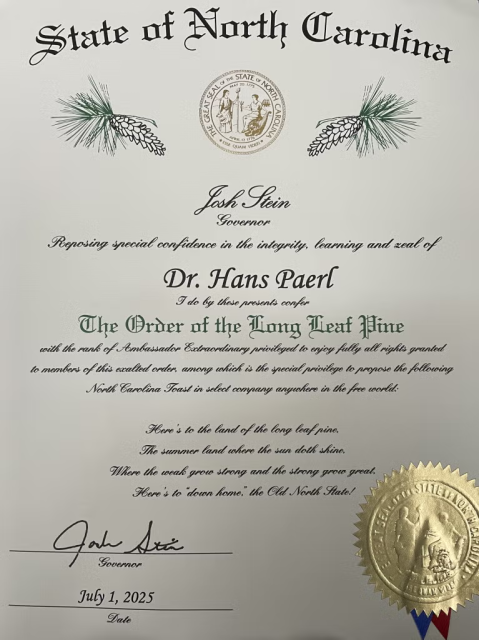
Order of the Long Leaf Pine. Photo Credit: UNC Chapel Hill
Brief Biography
Dr. Hans Paerl was born in 1947 in the Netherlands. At the age of 10 he and his family moved to California, where he earned an AA in Biology-Biochemistry from the College of San Mateo, as well as a B.S. in Biological Sciences and Ph.D. in Ecology-Limnology from UC Davis. In 1978, Dr. Paerl joined the UNC Institute of Marine Sciences, where he spent the majority of his career. During his time there he became internationally known for his work on water quality. Before retiring in June of 2025, Paerl published over 600 publications, aided in the creation of UNC's Environmental Program, and taught generations of future scientists, earning the moniker of “Carolina’s water warrior." Paerl intends to continue his efforts outside of the university to promote water quality having stated in a UNC article, “I’m not planning on ceasing my interests, dedication and service to helping preserve our precious aquatic ecosystems.”
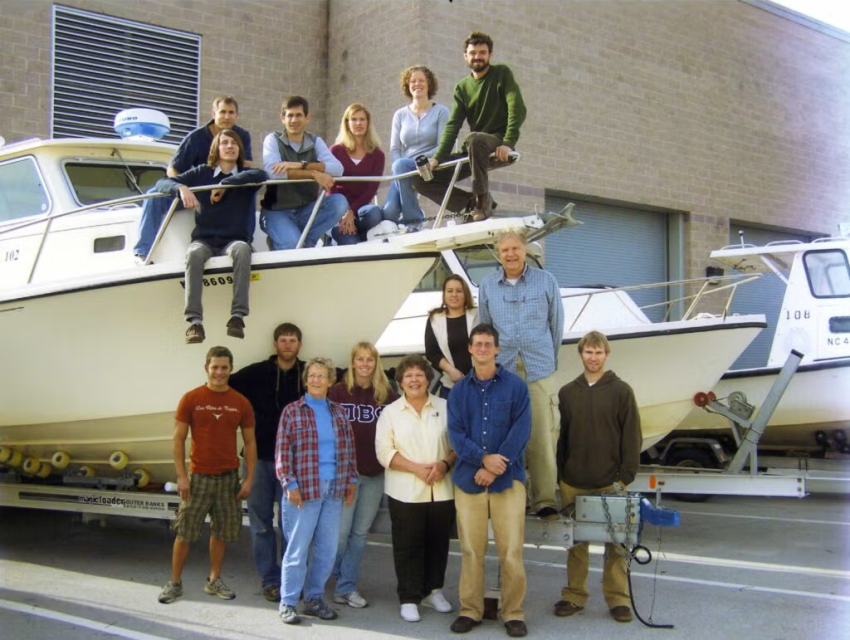
The Paerl Lab Staff & Students c. 2009. Photo Credit: The Paerl Lab
Dr. Hans Paerl’s involvement with APNEP has spanned roughly two decades. He initially served as a member of the Scientific Technical Advisory Committee from July 2004 – June 2007, later reprising his role in January 2013, where he has remained a member since.
ModMon and FerryMon
The Neuse River Estuary Modeling and Monitoring Project (ModMon) is a collaboration between UNC and NC-DEQ. The Paerl Lab is responsible for collecting bi-weekly water quality samples to monitor and assess nutrient-eutrophication dynamics, algal blooms, hypoxia, fish kills, related water quality issues pertinent to the public’s interests, and to provide science-based management decisions to state agencies. The data collected from this project can be viewed here.
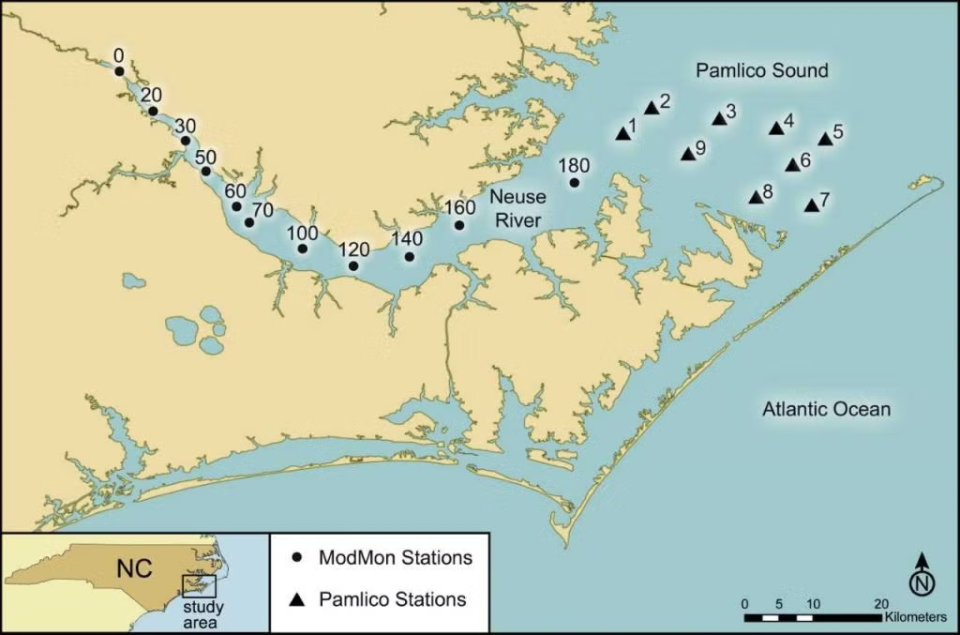
Map of ModMon Stations. Photo Credit: The Paerl Lab
FerryMon is another water quality monitoring project created by Paerl. Inspired by similar projects in the Baltic Sea, FerryMon utilizes two existing ferries, one in the Pamlico Sound, and the other in the Neuse River estuary, to collect water quality samples. This comes at little additional cost and has allowed for over twenty-five years of research in North Carolina’s waterways. The project falls under the APNEP Water Resources Monitoring & Assessment Team, of which Paerl is a member. Dr. Nathan Hall, a fellow STAC member and close collaborator of Paerl’s, summarizes the data collected.
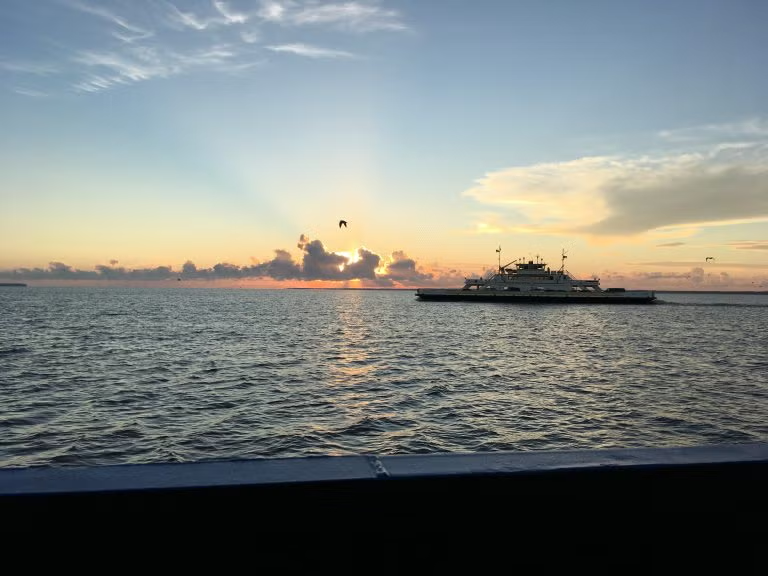
Monitoring ferry. Photo Credit: The Paerl Lab
WRRI Interview
We had the pleasure of seeing Dr. Hans Paerl at the 2026 WRRI Annual Conference. He took the time to answer a few questions regarding his work here in North Carolina.
How did you become involved with APNEP?
“That probably goes back to when I first got to UNC and the Institute ... my very first funded project was actually from Water Resources Research Institute here, helping solve the algal bloom problems on the Chowan River. And they had known that I had worked on nutrient issues using bioassays to look at nutrient limitation and how much reductions in nutrients are needed ... I was asked to be on advisory committees and things like that. So that's what I've been doing ever since I've been here, more or less ... So then Dean [Carpenter] came into the picture. Turns out Dean and I both graduated from the same university, UC Davis, he got a hold of me, and I’ve been with APNEP ever since.”
When reflecting on two decades collaborating with APNEP, Paerl added, “It was one of the original National Estuary Programs ... so I’m kind of a veteran.”
Does the Albemarle-Chowan region face unique environmental challenges?
“Yes ... the continuum from the Chowan River into Albemarle Sound is particularly sensitive to algal blooms. And the reason for that is that ... Albemarle Sound water flows into Pamlico Sound. There's no direct exchange with the coastal ocean, so as a result it has a very long retention time ...the nutrients are there and the organisms that form the blooms don't get washed out into the ocean very readily. So, I would say it's probably one of the most bloom-sensitive areas in the state, if not in the country ... my prediction is that the problem will only get worse unless we really have a comprehensive both nitrogen and phosphorus reduction strategy.”
Is a comprehensive reduction strategy something you think will happen in the foreseeable future?
“Yeah, and there’s been a lot of concern already in the Chowan-Albemarle, like around Edenton ... I think a lot of it depends on population density and geographic-political importance and the Northeast corner of the state is still not [somewhere with] a lot of sway ... but more and more it's becoming an issue because people's dogs are dying, fishermen complain about taste and odor problems with fish, low oxygen issues, and the bloom itself, the physical appearance of these blooms. So, yeah, it's been more and more in the news and also of concern and I think that this will just this will just increase over time. The question is what the state is willing to do about it.”
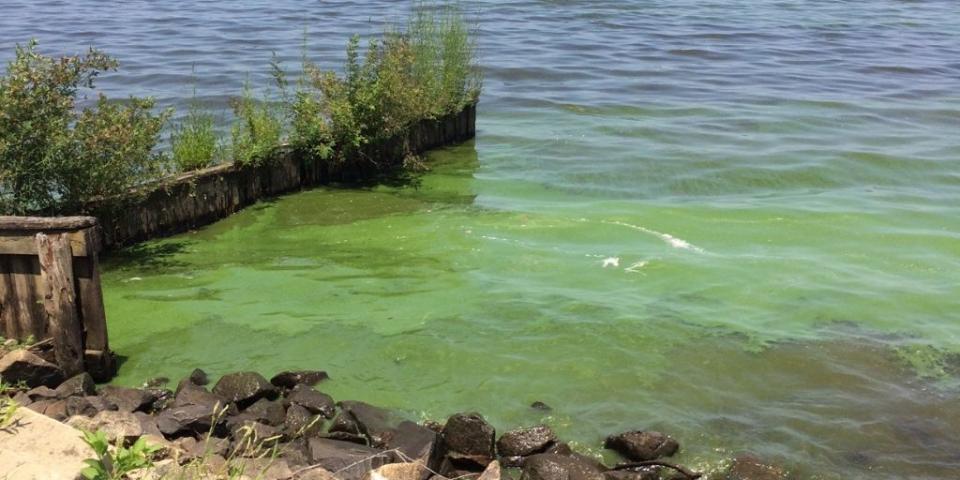
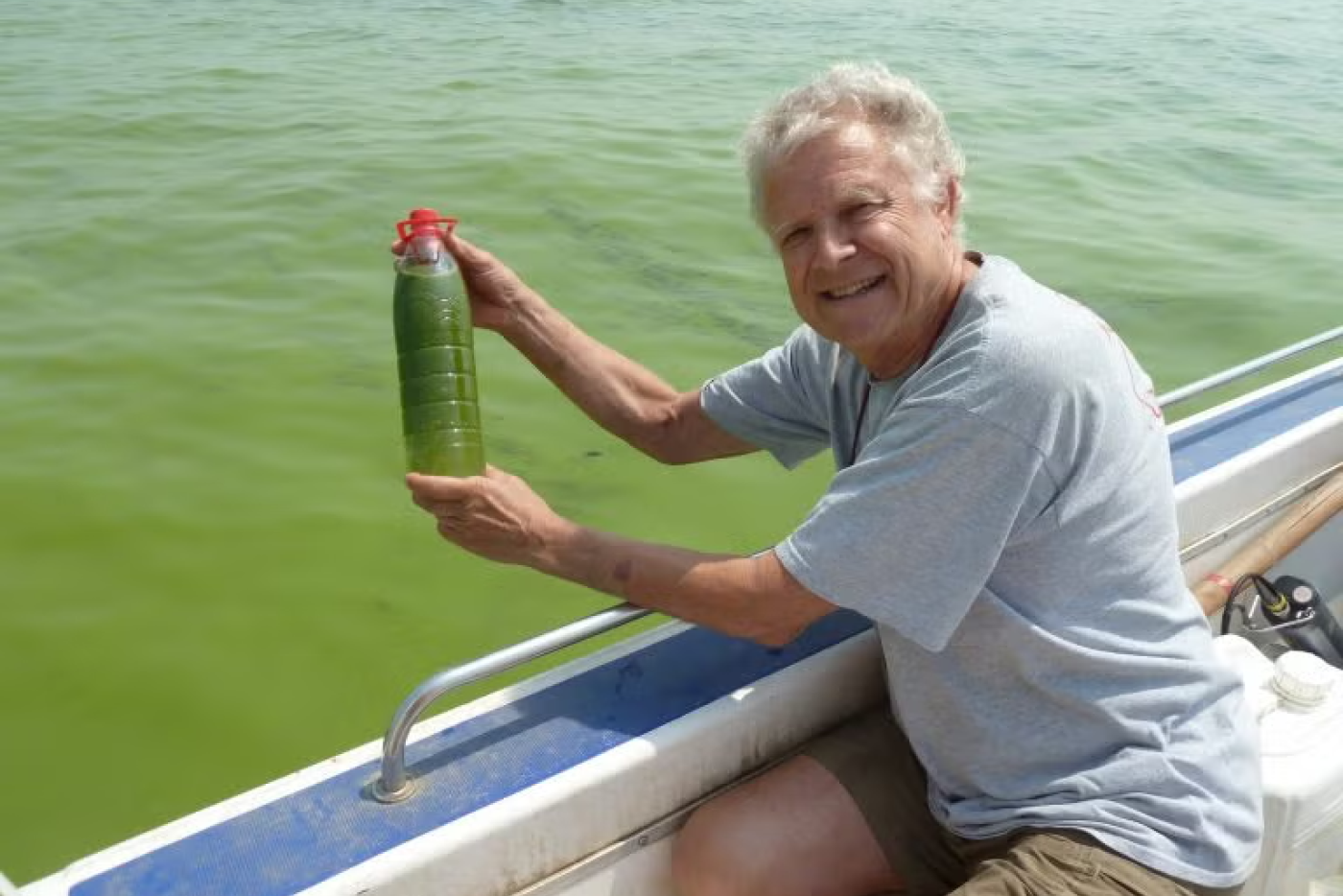
Algal bloom on the Chowan River. Photo Credit: CEEG
“But we have excellent citizens groups that are actively involved in sampling, collecting for us ... A lot of the folks that have moved into this area are retirees that are well-educated and want to do something, want to play an active role in the environment ... [W]e’ve partnered up with the Chowan-Edenton Environmental Group ... they're articulate, they're very science-oriented and they recognize the strength in linking up with more traditional laboratories and scientific studies, so it’s been a good partnership. I think it's a good example of how citizens can join with researchers and scientists to not only make the problem more prominent but putting pressure on helping solve the problem and protecting our estuary systems.”
What is one thing you would like to say to young people who are going into your line of work?
“Water is the most important resource that we have on Earth. You know, there's a lot of stuff going on about oil right now, but we can't drink oil ... Water can be used for drinking, for recreational use, for fisheries, et cetera ... we're never going to run out of jobs studying and preserving and saving our water resources, so if you're interested in science, water is a good subject.”
We thank Dr. Hans Paerl for taking the time to speak with us, and once again offer a most sincere congratulations for his well-deserved award.