Tribal Coastal Resilience Connections (TCRC)
Overview
The Tribal Coastal Resilience Connections (TCRC) team was developed in partnership with Tribal community liaisons. The team works to build environmental risk and adaptation planning capacity among Native Nations with present-day and ancestral ties to the Albemarle-Pamlico region through community led engagement. In addition to working with Indigenous communities, we also aim to educate non-Native resilience practitioners on best practices for including Tribes in agency, NGO, and university led environmental planning initiatives.
The TCRC team is focused on building inter-Tribal coalitions to increase awareness among Tribal communities on the risks of recurring extreme weather events, and to foster discussions about the relationship between ecological stability, community resilience and adaptation planning. The project concentrates efforts in the APNEP program area in southeast Virginia and northeastern North Carolina but aims to learn from and highlight great work that Tribal communities are already doing in other parts of Virginia and North Carolina, many of which have longstanding historical ties to the APNEP region.
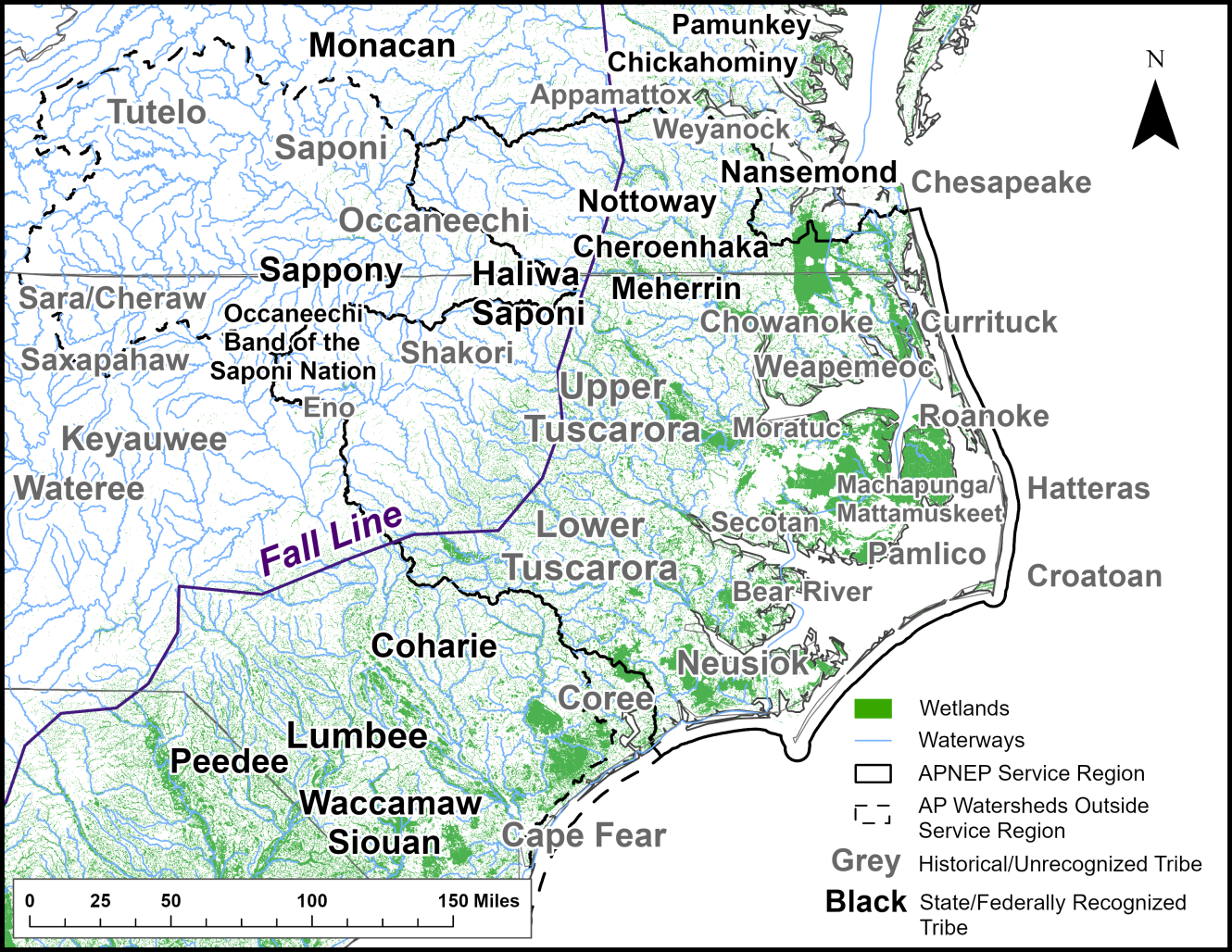
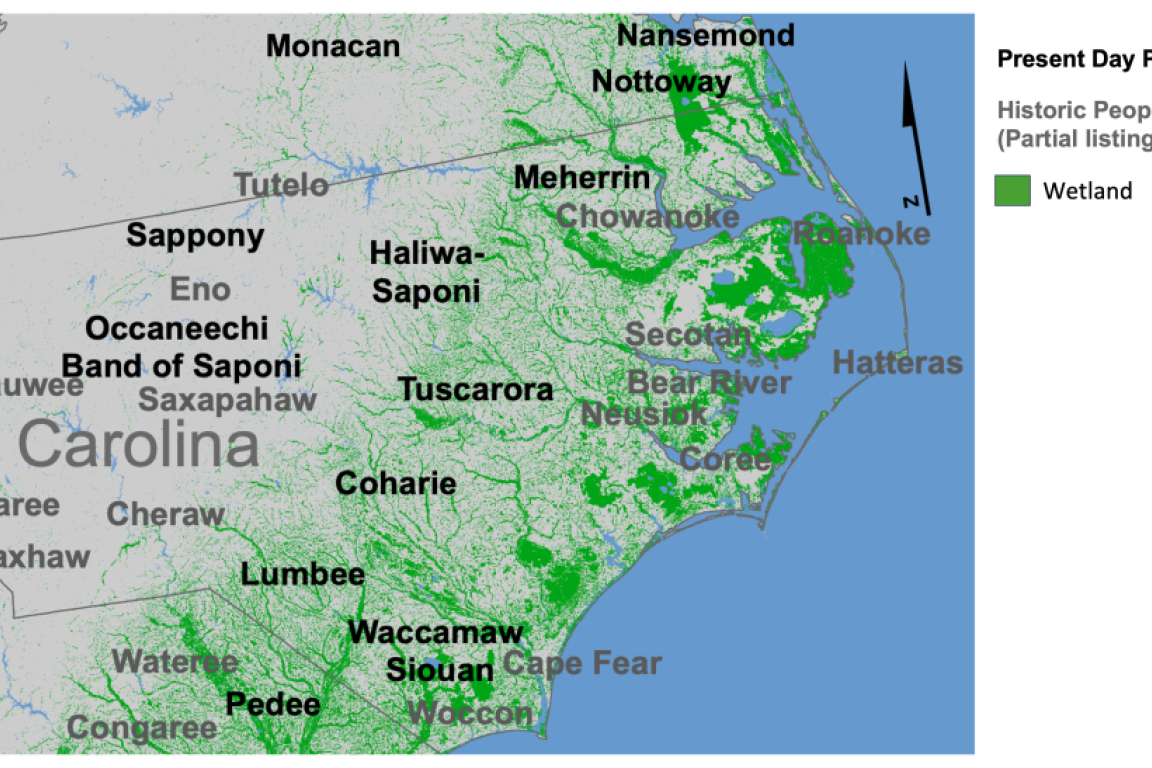
This map shows Indigenous nations located in and around the APNEP service area, with names in black denoting a state or federally recognized Tribe and those in grey denoting an unrecognized Tribe or a previously existent historical Tribe. The purple fall line denotes the geological boundary between the piedmont and coastal plain regions.
Background
The project was initially funded through supplemental funding awarded by the Environmental Protection Agency and developed by APNEP staff under advisement and in close partnership with representatives from tribal communities in the Albemarle-Pamlico watershed and coastal plain. It was designed to increase engagement between tribal organizations, government agencies, and university faculty, as well as to acknowledge the unique knowledge and cultural perspectives of tribal communities surrounding environmental change. APNEP initially partnered with the North Carolina Commission of Indian Affairs (NCCIA), NC State University (colleagues now with Duke University), and the Virginia Coastal Policy Center at the College of William and Mary (colleagues now with University of Virginia Institute for Environmental Negotiation) to guide project development. Other project advisors include the UNC American Indian Center, the North Carolina Office of Recovery and Resiliency, and the Southeast Climate Adaptation Science Center.
In the fall of 2020, the project team, led by Beth Roach (Tribal Councilwoman with the Nottoway Indian Tribe of Virginia), kicked off the project with the Tribal Coastal Resilience Connections Facebook page. Originally, the project envisioned in-person workshops and forums to share information on climate impacts and resilience planning strategies and to promote information sharing between tribal communities and resilience practitioners. Due to restrictions caused by the COVID-19 pandemic, the team engagement shifted to social media and virtual webinars and workshops. The social media page was established as a forum for Tribal community partners to share their present-day and ancestral connections to Albemarle-Pamlico watershed and coastal plain of Virginia and North Carolina. In addition to digital outreach, a graduate research assistant, under the guidance of Duke University faculty member and member of the Lumbee tribe Dr. Ryan Emanuel conducted an analysis to assess climate resilience planning and implementation projects by tribal governments and other tribal or inter-tribal organizations throughout the United States.
In October 2023, the project team briefed APNEP's Leadership Council on progress and take aways from this work and released the Tribal Coastal Resilience Phase I Report. The project supports implementation of North Carolina’s Executive Order 80 and the State Climate Risk and Resiliency Plan, similar directives in Virginia, and APNEP’s Comprehensive Conservation and Management Plan.
Phase II
The current TCRC phase is focused on expanding and enacting the initiatives detailed in the Phase I report, including the development of an interactive online mapping tool to support conservation initiatives in the Chowan Watershed (also supporting APNEP MOU implementation). Beyond individual conservation projects, this mapping work is intended to strengthen relationships among tribal communities, agencies, and academic partners. The team will use these mapping tools in conjunction with interorganizational partnerships and traditional knowledge to build an adaptation framework tailored to the Albemarle-Pamlico region (modeled after the WAMPUN framework described in the Phase I report) to assist with future resilience planning. The information will also provide a platform that can be utilized to educate agency staff on traditional ecological knowledge and best practices for collaboration with APNEP-area native communities. In addition to mapping work, as part of phase two, our team has performed outreach and at annual events such as the 2024 and 2025 NC Unity Conference, the 2024 Secotan Alliance, and the 2025 Coastal Geotools Conference.
Learn More:
- Take the Survey and Share Your Water Story:
- Sign up for the Heat Health Alert System:
- Climate and Public Health – NC Division of Public Health
- Environmental Justice and Indigenous Rights – Emanuel Lab Projects
- Great Coharie River Initiative – Coharie Tribe
- Awę́nheʔ í:kę haʔ à:węʔ - Water is Alive
- Press Release: APNEP partners with N.C. Commission of Indian Affairs to strengthen climate resilience in coastal region Tribal communities
- North Carolina Commission of Indian Affairs
- WAMPUM: An Indigenous Framework to advance water security in the face of sea level rise
- Virginia Secretary of the Commonwealth: Virginia Indians
- Fourth National Climate Assessment, Chapter 15: Tribes and Indigenous Peoples
- US Climate Resilience Toolkit: Tribal Resilience Resource Guide
- Guidelines for Considering Traditional Knowledge in Climate Change Initiatives
- Southeastern Climate Adaptation Science Center: Tribal Resources
- Dibaginjigaadeg Anishinaabe Ezhitwaad, Great Lakes: Tribal Adaptation Menu (TAM)